Stop Bogging Down in Wet Spring Grass
Why 35 HP is the new standard
The best mower for wet grass on a commercial route is one with enough torque to hold blade speed through thick, damp turf instead of slowing down or double-cutting. An underpowered machine forced from 5 mph to 3 mph loses about 40% of its daily mowing capacity — and if the property needs a second pass, the loss climbs past 70%. The Toro 4000 Series FX1000 60″ XL, with a 35 HP Kawasaki FX1000V, is built to avoid both.
Every landscaper knows the struggle of the spring rush. The grass is thick, it is constantly wet, and your route schedule is packed. When you hit heavy, damp turf with an underpowered mower, blade tip speed drops, the deck clogs, and the engine bogs down. Your operators are forced to slow to a crawl or double-cut the property just to leave a clean finish.
That inefficiency does not show up as a repair bill, so it rarely gets measured. It shows up as overtime, as properties pushed to tomorrow, and as a route that quietly stops being profitable for six weeks every spring.
What Does Bogging Down Actually Cost Per Day?
Mowing capacity is simple arithmetic: deck width times ground speed times efficiency. Using Exmark’s published productivity figures for a 60-inch deck at 80% efficiency — the rating that accounts for turns and overlap in real conditions — here is what losing ground speed does to an eight-hour day.
Scenario: one 60-inch commercial zero-turn, eight-hour working day, spring conditions.
| Condition | Sustainable ground speed | Acres per 8-hour day |
|---|---|---|
| Dry turf, full power | 5.0 mph — 2.42 acres/hr | 19.4 acres |
| Wet turf, underpowered | 3.0 mph — 1.45 acres/hr | 11.6 acres |
| Wet turf + double-cut | 3.0 mph, two passes — 0.73 acres/hr | 5.8 acres |
Now convert lost acres into lost revenue. Commercial mowing on larger properties bills roughly $25–$60 per acre.
| Situation | Acres lost per day | Revenue lost across a 6-week spring rush |
|---|---|---|
| Slowing to 3 mph to avoid bogging | 7.8 acres | $5,850 – $14,040 |
| Slowing and double-cutting | 13.6 acres | $10,200 – $24,480 |
Productivity figures from Exmark’s commercial mower productivity chart (60-inch deck, 80% efficiency rating, which the manufacturer notes “is more representative of actual mowing conditions as it allows for turns and overlapping”). Per-acre commercial rates from 2026 commercial lawn care pricing data. Spring rush modelled as 30 working days. Adjust to your own route and market.
A single underpowered machine can quietly cost you five figures across one Michigan spring — without ever breaking down, without a single repair invoice, and without anyone on the crew reporting a problem. They will just tell you the grass was heavy this year.
Why Horsepower and Torque Decide the Outcome
Blade tip speed is what cuts, not deck size
A clean cut depends on blade tip speed. When wet, heavy clippings load the deck, the engine has to fight to hold RPM. If it cannot, tip speed falls, the cut gets ragged, and clippings clump instead of discharging — which is exactly what forces the second pass.
Torque is what holds RPM under load
Peak horsepower is a headline number. Torque under load is what keeps blades turning at full speed when the deck is packed with wet grass. A large-displacement commercial V-twin holds RPM where a smaller engine falls off.
Deck design has to move the material
Power alone is not enough if the deck cannot evacuate heavy, wet clippings. Deck depth and baffle design determine whether material discharges cleanly or packs under the deck and clogs.
Ground speed is the profit variable
Everything above exists to protect one number: the speed you can hold and still leave a finish you would put your name on. Drop from 5 mph to 3 mph and you have cut your day’s capacity by 40% regardless of how good the machine looks parked.
Current Toro offers from our team at Outdoor Equipment Co.

How the Toro 4000 Series FX1000 60″ XL Handles Wet Turf
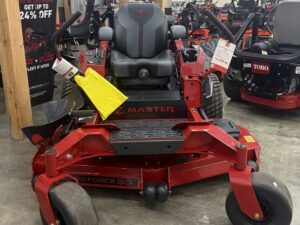
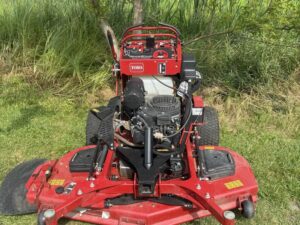
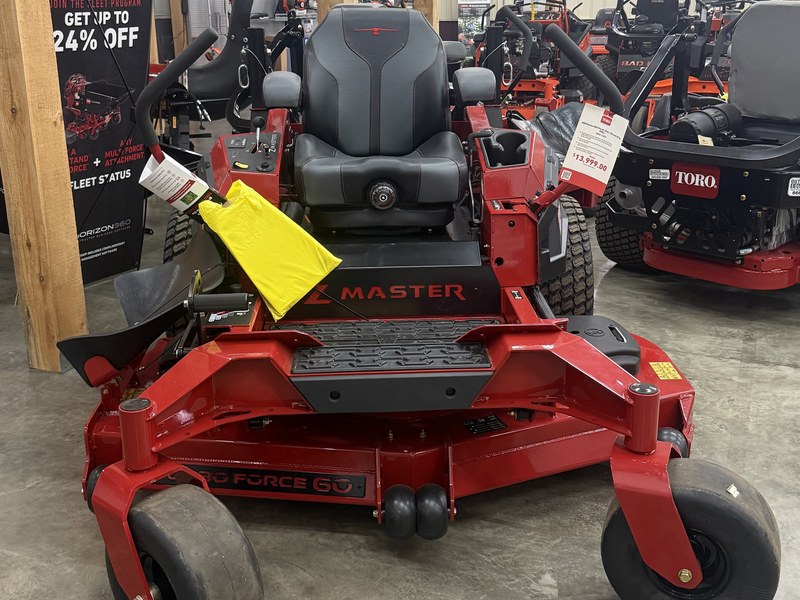
The solution is raw, uncompromised torque. The Toro 4000 Series FX1000 60-inch XL solves the wet-grass problem with a 35 HP Kawasaki FX1000V commercial V-twin. That powerplant provides the torque required to drive the 60-inch TURBO FORCE deck through thick, overgrown grass without losing blade speed.
Paired with heavy-duty commercial hydrostatic transmissions, operators can power through challenging spring conditions in a single pass — keeping route times predictable and profitable regardless of the weather.
| In thick, wet spring grass | Underpowered machine | Toro 4000 Series FX1000 XL |
|---|---|---|
| Engine | Falls off RPM under load | 35 HP Kawasaki FX1000V commercial V-twin |
| Blade tip speed | Drops when the deck loads up | Held through heavy material |
| Passes required | Often two | One |
| Sustainable speed | Crawl to ~3 mph | Full route speed |
| Route schedule | Slips, forces overtime | Predictable |
The Michigan Spring Problem
Michigan compresses the worst of this into a few weeks. Green-up arrives fast, spring rain keeps turf permanently damp, and every commercial crew in Metro Detroit and Greater Lansing is chasing the same first cuts inside the same narrow window. There is no slack in the calendar to absorb a 40% capacity loss.
The crews who get through spring without overtime are rarely working longer days. They are running machines that hold speed in wet turf, so a route that takes eight hours in June still takes about eight hours in May.
Frequently Asked Questions
What is the best mower for wet grass on a commercial route?
One with enough torque to hold blade tip speed through heavy, damp material so you can cut in a single pass at full route speed. The Toro 4000 Series FX1000 60″ XL uses a 35 HP Kawasaki FX1000V commercial V-twin paired with a 60-inch TURBO FORCE deck for exactly this.
How much productivity do you lose mowing wet grass?
Dropping from 5 mph to 3 mph on a 60-inch deck cuts an eight-hour day from about 19.4 acres to 11.6 — roughly 40%. If the property also needs a second pass, output falls to about 5.8 acres, a loss above 70%.
Why does wet grass make mowers bog down?
Wet clippings are heavier and stick together, loading the deck and forcing the engine to fight to hold RPM. When RPM falls, blade tip speed falls, the cut turns ragged, and clippings clump instead of discharging.
Is 35 HP overkill for a 60-inch deck?
Not on commercial routes in spring. The extra torque is not about top speed on dry turf — it is about holding blade speed when the deck is loaded, which is what lets you finish in one pass instead of two.
Does double-cutting really cost that much?
Double-cutting halves your acres per hour on that property. Across a six-week Michigan spring, a machine that regularly needs a second pass can represent $10,000 to $24,000 in mowing capacity you never billed.
Should I buy a commercial mower online or from a local Michigan dealer?
A local dealer like Outdoor Equipment Co stocks parts for the models we sell, has technicians who know the machine, and can prioritise a commercial account during the spring rush. Online purchases leave you in a mail-order parts queue with no service relationship — which is the expensive part when you are already behind.
Does Outdoor Equipment Co offer commercial financing?
Yes. Our team can walk through commercial financing options alongside a model-specific recommendation for your route. Call (866) 688-7847 or use the form below to discuss terms and current availability.
The Bottom Line
- Capacity loss: 40% from slowing to 3 mph, over 70% if you double-cut
- Season cost: $5,850–$24,480 across one six-week spring rush
- The fix: 35 HP Kawasaki FX1000V torque holding blade speed under load
- The result: one pass, full route speed, a schedule that holds
Don’t let spring growth dictate your schedule. Visit Outdoor Equipment Co to inspect the Kawasaki-powered Toro 4000 Series XL and upgrade your fleet with the horsepower required to dominate the spring rush.
Request More Information
Tell us how to reach you and which unit you have in mind. We’ll follow up with pricing and availability.