Stand-On vs. Zero-Turn on Slopes and Ditches
Which gives your crew more control on tricky ground?
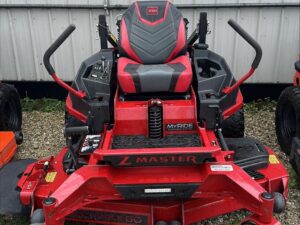
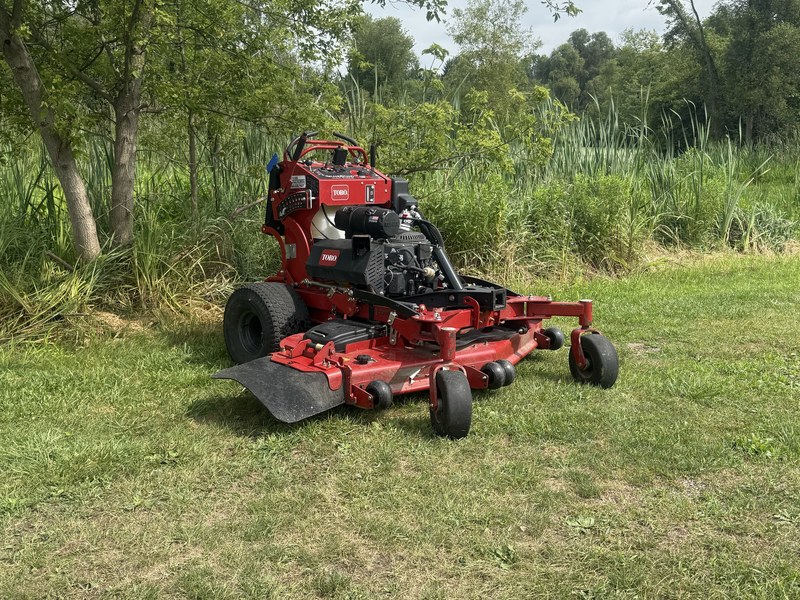
On slopes and ditch banks, a stand-on gives the operator more control. Standing lets them shift their weight uphill to keep the tires biting, see the ground better, and step off the back instantly if anything goes wrong. That is why crews with retention ponds and drainage ditches tend to prefer the Toro GrandStand MULTI FORCE 60″ for that part of the property.
Most commercial properties have one area everybody quietly dislikes mowing — the pond bank, the ditch line beside the parking lot, the slope behind the building. It is usually the slowest part of the job and the part where operators are most careful.
The good news is that this is largely an equipment question, and it has a clear answer.
Why Standing Changes the Physics
On a seated zero-turn, the operator’s weight is fixed. They sit where the seat puts them, and that is where their mass stays no matter what the ground is doing. If the machine starts to drift downhill, there is very little they can do to influence it.
Standing changes that completely. The operator becomes an active part of the machine’s balance — leaning into the hill shifts weight onto the uphill tires, which is exactly where you want it to keep traction. It is the same instinct you use walking across a slope, and it works for the same reason.
Three Practical Advantages
Weight you can move
Leaning uphill puts load on the uphill wheels and helps them hold. A seated operator simply cannot do this.
A better view of the ground
Standing puts your eyes higher and further forward, so you can see the edge of a ditch, a washout, or a soft patch before you reach it rather than after.
You can step off
This is the one operators mention most. If something does go wrong, you step straight off the back of the platform. There is no unbuckling and no climbing out — you are simply standing on the ground.
| On a ditch bank or pond slope | Seated zero-turn | Toro GrandStand MULTI FORCE |
|---|---|---|
| Operator weight | Fixed in the seat | Shifts uphill to hold traction |
| View of the ground ahead | Lower, seated sightline | Higher and further forward |
| Getting off quickly | Climb out of the seat | Step off the back |
| Turf marking on slopes | More prone to scuffing | Better traction, gentler turns |
| Cutting width | Full width | Full 60 inches — no compromise |
2026 Toro 60″ GrandStand MULTI FORCE
The stand-on platform crews choose for pond banks, ditch lines and uneven ground — with the same 60-inch cutting width as a full-size zero-turn. Available now in Michigan.
View This Unit See Toro OffersMichigan Properties Have a Lot of This Ground
If you maintain commercial sites around Metro Detroit or Greater Lansing, you already know how common retention ponds and drainage swales are here. Stormwater management is built into almost every commercial development, which means almost every contract comes with a bank to mow.
Spring makes it trickier still. Michigan ground is soft and saturated for weeks after thaw, so a slope that is perfectly manageable in August can be genuinely slick in May — exactly when your schedule is fullest.
No mower makes a wet slope safe. Manufacturer guidance on maximum slope, tyre choice and conditions still applies, and there are banks that should be handled with a walk-behind or a trimmer instead. What a stand-on does is give a trained operator more control and a faster way off the machine.
Which Should You Choose?
If your properties are mostly flat and open, a seated zero-turn is comfortable and fast, and there is no reason to change. Plenty of our customers run exactly that.
But if your route includes pond banks, ditch lines, or rolling ground — or if you have operators who dislike a particular property for good reason — a stand-on is worth trying. The honest test is to bring the machine to the slope that worries you and see how it feels.
Common Questions
Is a stand-on mower better for slopes than a zero-turn?
For most crews, yes. Standing lets the operator shift weight onto the uphill tires to maintain traction, gives a higher sightline over the ground ahead, and allows them to step straight off the platform if needed. Seated machines keep the operator’s weight fixed.
Why does shifting weight matter on a hill?
Traction depends on load. Leaning uphill puts more weight on the uphill wheels, which helps them grip. A seated operator cannot meaningfully change where their weight sits.
Is a stand-on safe on any slope?
No mower is. Always follow the manufacturer’s slope limits and avoid wet or saturated banks. Some slopes are best handled with a walk-behind or trimmer. A stand-on gives more control within safe limits, not permission to exceed them.
Do you lose cutting width with a stand-on?
Not with this one. The GrandStand MULTI FORCE cuts a full 60 inches, the same as a full-size zero-turn, so route productivity stays intact.
Are stand-on mowers tiring to operate all day?
Less than most people expect. The platform is cushioned, and many operators find standing easier on their back than sitting through hours of vibration. It is worth letting a crew member try one for an afternoon.
Can we demo one on our own property?
That is the best way to decide. Talk to our commercial team about arranging a demonstration on the ground that actually concerns you rather than on a flat lot.
Does Outdoor Equipment Co offer financing?
Yes. Our team can walk through financing options alongside a recommendation based on your terrain and crew. Call (866) 688-7847 or use the form below.
The Short Version
- Standing lets the operator move their weight onto the uphill tires
- Better sightlines over ditch edges and soft ground
- Step off the back instantly if anything goes wrong
- Full 60-inch cut — no productivity trade-off
If there is a slope on your route that nobody volunteers for, bring it up with us. Stop by Outdoor Equipment Co and we will talk through whether the GrandStand MULTI FORCE is the right answer for that property — or whether something else suits it better.
Request More Information
Tell us how to reach you and which unit you have in mind. We’ll follow up with pricing and availability.