The True Cost of Mower Downtime
How to protect your landscaping profits
The commercial mower downtime cost for a landscaping crew runs roughly $1,650 to $3,480 for a single machine down for one working day — and the repair invoice is only 5–15% of that. The rest is billable hours never invoiced, crew wages paid for idle time, and recovery overtime. Reducing that exposure means buying equipment built past the point of failure, which is what the Toro Z Master 5000 is engineered for.
For a commercial landscaping business, the purchase price of a zero-turn mower is only a fraction of its true cost. The real expense is downtime. When a mower goes down mid-route due to a bent deck, a blown spindle, or a cracked frame, the financial impact compounds immediately. You lose billable hours, you pay crews to stand around, and you risk damaging your reputation with commercial clients who expect clockwork reliability.
If you are running consumer-grade or light-commercial equipment on heavy routes, you are bleeding margin through repair delays — and most owners never see it, because the loss never shows up as a line item. It hides inside overtime, inside the callback you comped, inside the contract that quietly went out to bid.
At Outdoor Equipment Co, we outfit and service commercial crews across Metro Detroit, Greater Lansing, and Northern Michigan. The pattern we see every season is the same: the owners who track downtime buy differently than the owners who don’t.
What Does Commercial Mower Downtime Actually Cost Per Day?
The most useful way to answer this is to stop thinking about the repair bill and start counting the hours the machine was supposed to be earning. Here is the framework we walk through with fleet owners — plug in your own numbers.
Scenario: one commercial zero-turn out of service for a single working day, three-person crew, full-day route.
| Cost component | Industry basis | Ballpark range |
|---|---|---|
| Lost billable revenue | Commercial crews bill $40–$80/hr per worker — 3 workers × 8 hours | $960 – $1,920 |
| Idle crew wages | You still pay them. Median landscaping wage $18.31/hr — 2 workers idled ~6 hours | $220 – $330 |
| Recovery overtime | Catching the route back up at 1.5× base — crew of 3 × 4 hours | $330 – $490 |
| Transport & diagnostic | Shop pickup $30–$100, diagnostic fee $35–$90 | $65 – $190 |
| Parts & labor | Spindle assembly $60–$125; shop labor $55–$135/hr. The invoice everyone fixates on | $75 – $550 |
| Client churn risk | Contract value at risk after repeat missed visits | Unbudgeted |
| True cost — one machine, one day | $1,650 – $3,480 | |
The repair invoice accounts for roughly 5–15% of what that day actually cost you. Everything else is revenue you never billed and wages you paid anyway. And this is a one-day figure — a machine that goes down six times across a Michigan season represents roughly $9,900 to $20,900 in true cost, which is well into the price of the commercial machine that would not have failed.
Ranges reflect US national averages as of 2026: crew billing and per-acre rates from commercial lawn care cost data, wages from the U.S. Bureau of Labor Statistics (grounds maintenance workers, median $18.50/hr; landscaping and groundskeeping workers, $18.31/hr, May 2024), and repair figures from 2026 mower repair pricing guides. Adjust to your local market — metro rates run higher.
Run that exercise honestly and the conclusion is almost always the same: the cheapest mower on the lot is rarely the cheapest mower to own.
The Four Failure Points That Put Commercial Mowers Out of Service
1. Stamped decks that deform on impact
A stamped deck is pressed from thinner steel. Hit a hidden stump, an irrigation head, or a buried chunk of concrete and it deforms. A deformed deck does not just cut poorly — it changes blade geometry, stresses spindles, and starts a chain of failures downstream.
2. Spindle bearings that die from skipped greasing
Greaseable spindles depend on someone actually greasing them, daily, on every machine, during the busiest weeks of the year. In real crews, that does not happen. Skipped maintenance is the single most common root cause behind catastrophic spindle failure.
3. Frames not rated for the hours you run
Residential frames are engineered around weekend duty cycles. Run one 40+ hours a week on rough commercial ground and fatigue cracking is a question of when, not if.
4. Fuel systems that will not start on cold mornings
A machine that will not start is downtime, even if nothing is broken. Ethanol-degraded carburetors cost Michigan crews the first hour of the day far more often than owners realize.
Our own walkthrough of the Toro Z Master 5000 — According to Max, Episode 4.

How the Toro Z Master 5000 Is Engineered to Reduce Downtime
Stopping this margin leak requires investing in equipment overbuilt for the realities of commercial use. The Toro Z Master 5000 is engineered specifically to eliminate the common failure points above.
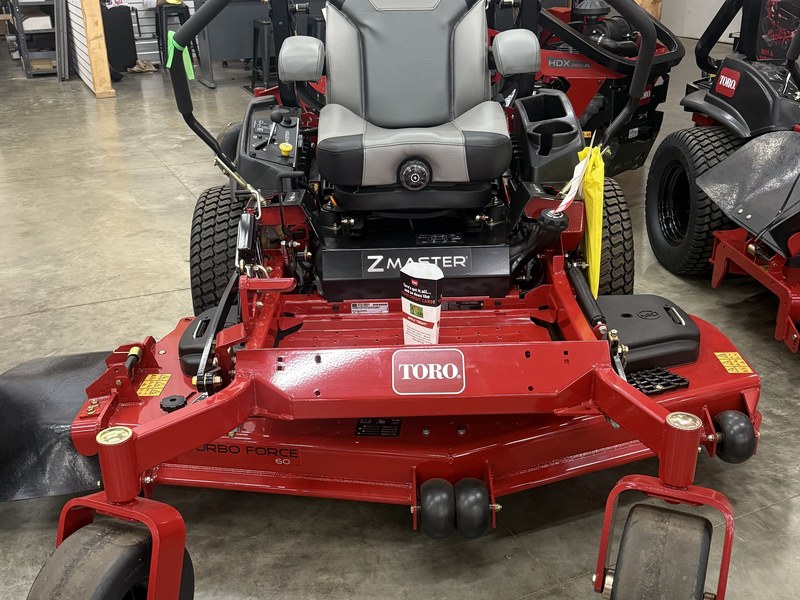
Its 60-inch TURBO FORCE deck is fabricated from high-strength 7-gauge steel, capable of absorbing impacts from hidden debris that would destroy a stamped deck. Fabricated construction means the deck holds its geometry after the kind of hit that ends a lesser machine’s season.
It also uses maintenance-free spindle bearings, which removes the daily greasing requirement entirely. This matters more than it sounds: it takes the most commonly skipped maintenance task off your crew’s plate and eliminates the failure mode that follows from skipping it.
| Failure point | Consumer / light-commercial | Toro Z Master 5000 |
|---|---|---|
| Deck construction | Stamped steel, deforms on impact | 7-gauge fabricated TURBO FORCE, 60″ |
| Spindle maintenance | Daily greasing required | Maintenance-free spindle bearings |
| Duty cycle | Weekend / homeowner use | Built for commercial route hours |
| Fuel system | Carbureted, ethanol-sensitive | Kohler EFI option, no choke |
| Parts & service | Big-box, mail-order waits | Local dealer stock at Outdoor Equipment Co |
Downtime in Michigan: The Spring Compression Problem
Michigan’s mowing season is short and front-loaded. Spring green-up arrives fast, the grass is thick and wet, and every commercial crew in Metro Detroit and Greater Lansing is trying to complete the same first cuts inside the same narrow window. Downtime in April and May does not cost you one day — it costs you a slot in a compressed calendar you cannot get back.
The failures we see most on our service bench in spring trace back to two things — ethanol-degraded fuel left in the tank over a long winter, and decks that took a hit the previous fall and were never checked. Both are avoidable, and both are cheaper to prevent than to schedule around.
Why Local Dealer Support Is Part of the Downtime Equation
Equipment specs only get you halfway. The other half of downtime is how fast you get back up. A machine bought from a big-box retailer sends you into a mail-order parts queue. A machine bought from your local Toro dealer means parts on a shelf nearby, technicians who know the model, and a service department with a reason to prioritize a commercial account.
Frequently Asked Questions
How much does commercial mower downtime cost per day?
For a three-person commercial crew, one mower out of service for a single working day typically costs $1,650 to $3,480. That breaks down as $960–$1,920 in lost billable revenue (crews bill $40–$80/hr per worker), $220–$330 in idle crew wages, $330–$490 in recovery overtime, $65–$190 in transport and diagnostic fees, and $75–$550 in parts and labor. The repair invoice most owners focus on is only 5–15% of the total.
What causes the most commercial mower downtime?
Four failure points dominate: stamped decks deforming on impact, spindle bearing failure from skipped greasing, frame fatigue on machines not rated for commercial hours, and fuel system problems from ethanol degradation.
Is a fabricated deck really better than a stamped deck?
For commercial routes, yes. The Toro Z Master 5000 uses a 7-gauge fabricated TURBO FORCE deck that absorbs impacts from hidden debris. A stamped deck deforms under the same hit, which changes blade geometry and stresses spindles downstream.
Do maintenance-free spindles actually reduce failures?
They remove the most commonly skipped daily maintenance task on a commercial crew. Since skipped greasing is a leading root cause of catastrophic spindle failure, eliminating the requirement eliminates the failure mode.
Should I buy a commercial mower online or from a local Michigan dealer?
Downtime is decided by how fast you get back up, not just by the spec sheet. A local dealer like Outdoor Equipment Co stocks parts for the models we sell, has technicians who know the machine, and can prioritize a commercial account during the spring rush. Online purchases leave you in a mail-order parts queue with no service relationship — which is the expensive part.
Does Outdoor Equipment Co offer commercial financing on the Z Master 5000?
Yes. Our team can walk through commercial financing options alongside a model-specific recommendation for your route. Call (866) 688-7847 or use the form below to discuss terms and current availability.
The Bottom Line
- True cost: $1,650–$3,480 per machine, per day out of service
- The repair bill: only 5–15% of what the day actually cost
- The fix: fabricated 7-gauge deck, maintenance-free spindles, commercial duty cycle
- The other half: local parts stock and a service department that knows your account
Downtime is the most expensive line item in a landscaping business that nobody puts on a spreadsheet. Put it on the spreadsheet, and the equipment decision makes itself.
Request More Information
Tell us how to reach you and which unit you have in mind. We’ll follow up with pricing and availability.